Chicken Road — review
Three risk modes
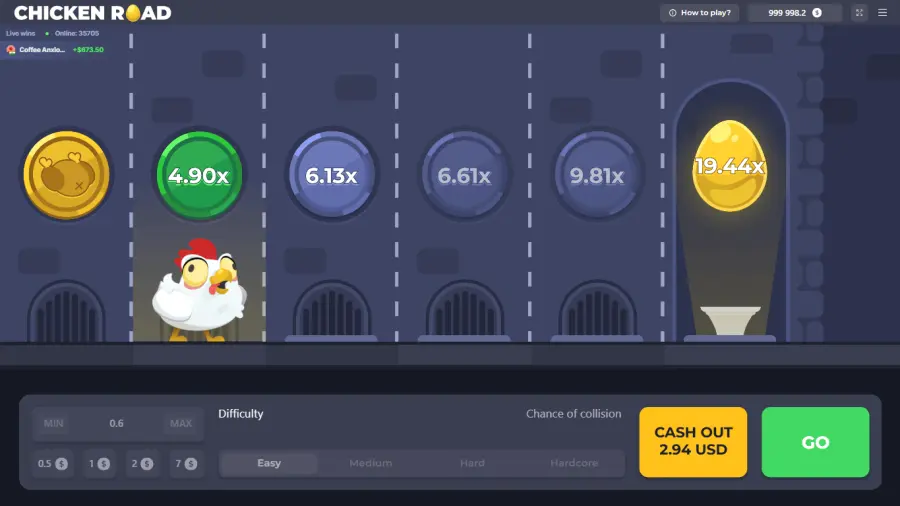
Every Chicken Road round opens with a variance picker: Easy, Medium or Hard. Easy runs the widest, most tolerant curve — cash-outs between 1x and 3x land frequently, and the session variance data we pull off the streaming stack shows roughly 45% of Easy rounds crashing under 1.8x, which is exactly the pattern that stretches a small bankroll while the multiplier bar climbs. Medium loosens the payout window and shifts the mean cash-out higher, with the productive band sitting between 2x and 10x.
Hard mode is where the deep tail actually lives. Cash-out density plunges — fewer than one Hard round in six lands anything at all — but that tail stretches the full 3x to 500x range, and the game's headline 20,000x cap sits right at the top of Hard-mode play. Because all three bands collapse to the same 98.00% RTP over a long enough sample, the pick is purely about which variance envelope you want under you: Easy for session length, Hard for the deep-tail hunt.
Chicken Road doesn't ship the sequel's mid-round toolkit, so mode-hopping between rounds is your entire strategic surface. From the round-latency data we log, our most consistent regulars orchestrate sessions around a rhythm of roughly eight Easy rounds bookending each single Hard swing — funding the Hard hunt out of Easy cash-outs and locking in gains the second a 100x+ Hard round actually hits.
Manual and auto cash-out
Interface stays minimal on purpose. A dominating manual cash-out button owns the centre of the screen — press it any moment between round start and the crash and you bank whatever multiplier is live at that instant. Chicken Road has no partial cash-out button (that mechanic only exists in Chicken Road 2); the button here locks in your full stake at the current multiplier or leaves you with nothing.
Top-right of the crash panel is the auto cash-out field. Enter 2.00 and the round self-locks the moment the multiplier crosses 2.00x on every future round. Preset recommendations from our streaming team: 1.5x to 2.2x on Easy, 3x to 5x on Medium, and leave the target open above 10x on Hard for the deep tail. Both cash-out modes are fully available in demo, so you can rehearse preset ranges before touching real C$.
Strategy
Chicken Road turns session discipline into the entire game. With no bonus-round tail hiding somewhere in the maths, everything comes down to stake sizing and stop-loss thresholds. A sensible shape at Spin247:
- Session bankroll: 150x your base stake (C$15 at the C$0.10 floor) — enough runway to absorb a Hard cold streak
- Stake sizing: 0.5-1% of the roll per round; never ramp after a loss
- Auto cash-out target: 2x on Easy, 3x-5x on Medium, open target on Hard
- Mode discipline: any 100x+ Hard cash-out is your cue to cool down to Easy
- Session loss-stop: 30% of the session bankroll and you walk
Because our welcome-bonus rollover caps individual stakes at C$5, we suggest Medium with the auto cash-out preset at 3.00x for wagering runs — predictable clearance progress with just enough tail to catch the odd 50x that noticeably accelerates the rollover.
Mobile
The 2023 client defaults to landscape orientation, which introduces a small friction on iPhone — the cross-lane grid needs the extra horizontal width to breathe properly. Rotate the phone and the layout unlocks: cash-out button drops directly under thumb reach, the multiplier readout stays legible even on 5.5″ screens. Full HTML5 asset pack weighs in around 2.5 MB, so a full session over Canadian mobile data is negligible in bytes.
Interac e-Transfer top-ups clear in around 30 seconds from a phone while a live Chicken Road round is on the screen. Battery drain sits at roughly 3-5% per hour of continuous play — noticeably lighter than a video slot because there's no reel-spin particle system for the GPU to render. Flip on the browser's landscape lock if you're settling in for more than a handful of rounds.
Chicken Road vs Chicken Road 2 — differences
Think of the 2024 sequel as a strict superset built on the same core. Chicken Road holds a shared 98.00% RTP across three variance bands; Chicken Road 2 keeps the RTP fixed but bolts on a fourth Extra Hard band that lifts the ceiling from 20,000x to 25,000x. The sequel additionally slots in random powerups (×2 multiplier boost or bonus coins) at roughly one round in twelve, plus that 50% partial cash-out button the original doesn't include.
At the interface level the original defaults to landscape whereas the sequel is portrait-first on phones. If you want a cleaner, more predictable crash rhythm with zero mid-round randomness intruding, stay on the original Chicken Road — the maths are identical on the three shared bands and the game is materially easier to plan around. If the higher ceiling and the hedge tools are what you're after, jump to Chicken Road 2.
 S
S 🐔
🐔
 CHICKEN
 DRAGON
 BIGGER
 AMAZING
 CAISHEN
 WISH
WISH